


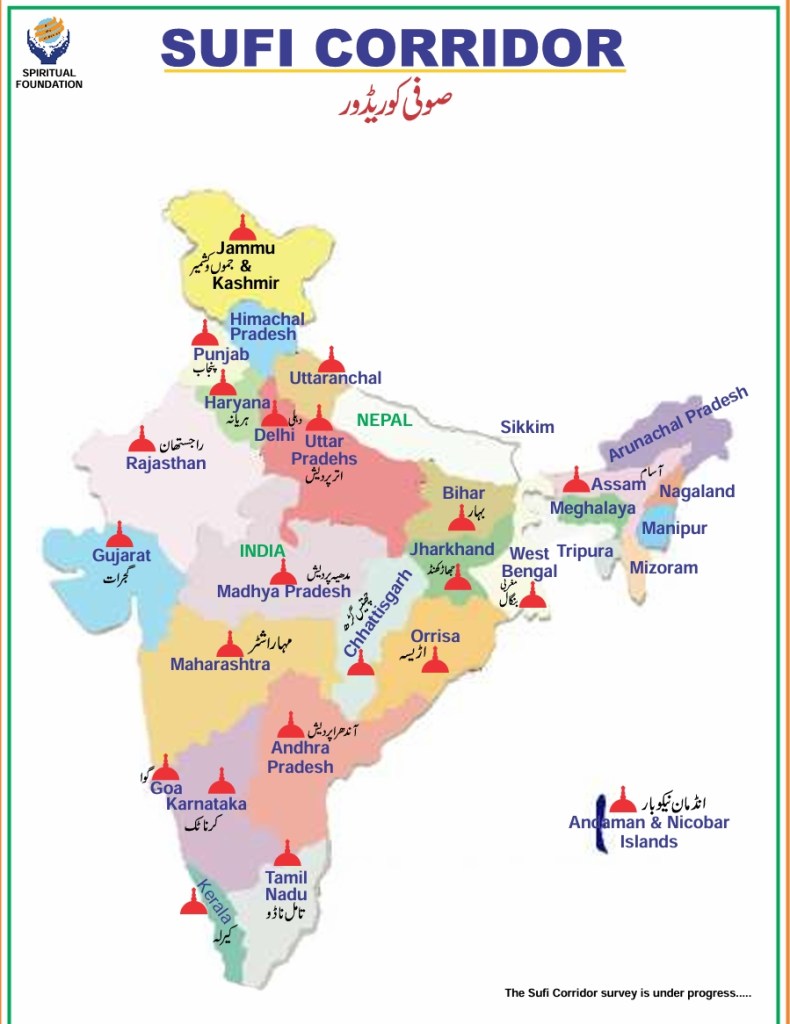
The Sufi Corridor is a conceptual route that highlights significant Sufi sites, mainly in India and Pakistan, showcasing the deep-rooted Sufi traditions in the region. It focuses on the legacy of Sufi saints, their shrines, and the spiritual, cultural, and architectural impact of Sufism.
Notable Sufi Sites in the Sufi Corridor:
- Rauza Mandhali Sharif (Punjab, India)
- Located near Phagwara, this shrine was established in 1785 by Hazrat Abdullah Shah Qadri. It remains an important spiritual center, attracting devotees during its annual Urs celebrations.
- Sheikh Chilli’s Tomb (Haryana, India)
- This Mughal-era complex in Thanesar includes a madrasa and tombs dedicated to the Sufi saint Sheikh Chilli. The architecture is a blend of Persian and Indian styles, reflecting the cultural synthesis of the era.
- Ajmer Sharif Dargah (Rajasthan, India)
- The resting place of Hazrat Khwaja Moinuddin Chishti, one of the most revered Sufi saints of the Chishti order. This dargah is visited by millions annually, including people of all faiths.
- Sarkhej Roza (Gujarat, India)
- A mosque and tomb complex dedicated to Shaikh Ahmed Ganj Baksh. Known for its Indo-Persian architecture, it symbolizes the fusion of Islamic and local cultural influences.
- Data Darbar (Lahore, Pakistan)
- The shrine of Hazrat Ali Hujwiri, also known as Data Ganj Bakhsh, is one of the most significant Sufi sites in Pakistan, serving as a spiritual center for millions of devotees.
- Baba Farid’s Dargah (Pakpattan, Pakistan)
- The shrine of Hazrat Baba Farid, a foundational figure in the Chishti Sufi order, is an important site for Sufi followers and Punjabi spiritual traditions.
The Sufi Corridor aims to preserve and promote the teachings of love, unity, and tolerance associated with Sufi saints. It also serves as a bridge for interfaith harmony, attracting scholars, spiritual seekers, and tourists interested in Sufism’s enduring legacy.
he Sufi Corridor is a proposed spiritual and cultural route that connects key Sufi shrines and heritage sites across India and Pakistan. It celebrates the profound influence of Sufi saints in the region, emphasizing their message of love, peace, and spiritual enlightenment. The corridor is envisioned to boost pilgrimage tourism and promote interfaith harmony by preserving and showcasing the rich legacy of Sufism.
Historical and Cultural Significance of the Sufi Corridor
Sufism has played a major role in shaping the spiritual and social fabric of South Asia for centuries. Sufi saints, also known as Auliya (Friends of God), spread their teachings through poetry, music, and humanitarian service. They played a vital role in bridging cultural and religious divides, often acting as mediators between different communities.
The Sufi Corridor aims to:
- Connect Prominent Sufi Shrines: Linking famous dargahs and khanqahs (Sufi lodges) across the region.
- Promote Spiritual Tourism: Encouraging visitors to experience the mystical traditions of Sufism.
- Preserve Heritage: Protecting ancient dargahs, manuscripts, and architectural marvels related to Sufi saints.
- Encourage Interfaith Harmony: Spreading the universal Sufi message of love and unity.
Key Shrines Along the Sufi Corridor
In India:
- Ajmer Sharif Dargah (Rajasthan) – Shrine of Khwaja Moinuddin Chishti, the founder of the Chishti order in India.
- Haji Ali Dargah (Mumbai, Maharashtra) – A famous shrine built on an islet, dedicated to Pir Haji Ali Shah Bukhari.
- Nizamuddin Auliya Dargah (Delhi) – The resting place of Hazrat Nizamuddin Auliya, a prominent Sufi saint of the Chishti order.
- Baba Farid Dargah (Faridkot, Punjab) – A major Sufi pilgrimage site associated with Baba Farid, known for his Punjabi poetry.
- Kakori Sharif (Uttar Pradesh) – The shrine of Hazrat Shah Barkatullah, an influential Sufi saint.
- Sheikh Chilli’s Tomb (Haryana) – A beautifully designed Mughal-era shrine in Thanesar.
- Sarkhej Roza (Gujarat) – A stunning Indo-Persian architectural site dedicated to Sufi saint Shaikh Ahmed Ganj Baksh.
In Pakistan:
- Data Darbar (Lahore) – The shrine of Hazrat Ali Hujwiri (Data Ganj Bakhsh), a major center of Sufi devotion.
- Baba Farid Dargah (Pakpattan, Punjab) – One of the most important Chishti Sufi shrines.
- Shahbaz Qalandar Dargah (Sehwan, Sindh) – The resting place of Hazrat Lal Shahbaz Qalandar, known for his mystical poetry.
- Bahauddin Zakariya Dargah (Multan, Punjab) – The shrine of a prominent Sufi saint of the Suhrawardi order.
- Bulleh Shah Dargah (Kasur, Punjab) – The resting place of the famous Punjabi Sufi poet Hazrat Bulleh Shah.
- Shah Abdul Latif Bhittai (Sindh) – A major shrine dedicated to Sindh’s most famous Sufi poet.
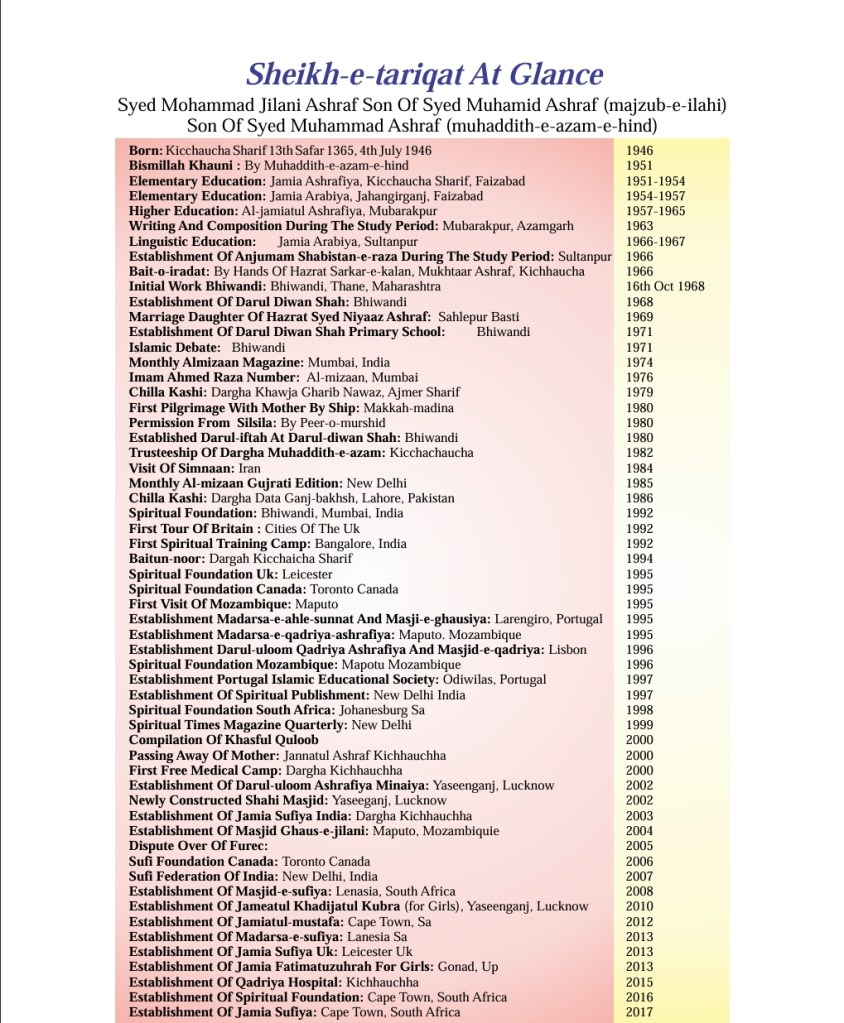
Sheikh-e-tariqat At Glance
Syed Mohammad Jilani Ashraf Son Of Syed Muhamid Ashraf (majzub-e-ilahi)
Son Of Syed Muhammad Ashraf (muhaddith-e-azam-e-hind)
Born: Kicchaucha Sharif 13th Safar 1365, 4th July 1946 1946
Bismillah Khauni : By Muhaddith-e-azam-e-hind 1951
Elementary Education: Jamia Ashrafiya, Kicchaucha Sharif, Faizabad 1951-1954
Elementary Education: Jamia Arabiya, Jahangirganj, Faizabad 1954-1957
Higher Education: Al-jamiatul Ashrafiya, Mubarakpur 1957-1965
Writing And Composition During The Study Period: Mubarakpur, Azamgarh 1963
Linguistic Education: Jamia Arabiya, Sultanpur 1966-1967
Establishment Of Anjumam Shabistan-e-raza During The Study Period: Sultanpur 1966
Bait-o-iradat: By Hands Of Hazrat Sarkar-e-kalan, Mukhtaar Ashraf, Kichhaucha 1966
Initial Work Bhiwandi: Bhiwandi, Thane, Maharashtra 16th Oct 1968
Establishment Of Darul Diwan Shah: Bhiwandi 1968
Marriage Daughter Of Hazrat Syed Niyaaz Ashraf: Sahlepur Basti 1969
Establishment Of Darul Diwan Shah Primary School: Bhiwandi 1971
Islamic Debate: Bhiwandi 1971
Monthly Almizaan Magazine: Mumbai, India 1974
Imam Ahmed Raza Number: Al-mizaan, Mumbai 1976
Chilla Kashi: Dargha Khawja Gharib Nawaz, Ajmer Sharif 1979
First Pilgrimage With Mother By Ship: Makkah-madina 1980
Permission From Silsila: By Peer-o-murshid 1980
Established Darul-iftah At Darul-diwan Shah: Bhiwandi 1980
Trusteeship Of Dargha Muhaddith-e-azam: Kicchachaucha 1982
Visit Of Simnaan: Iran 1984
Monthly Al-mizaan Gujrati Edition: New Delhi 1985
Chilla Kashi: Dargha Data Ganj-bakhsh, Lahore, Pakistan 1986
Spiritual Foundation: Bhiwandi, Mumbai, India 1992
First Tour Of Britain : Cities Of The Uk 1992
First Spiritual Training Camp: Bangalore, India 1992
Baitun-noor: Dargah Kicchaicha Sharif 1994
Spiritual Foundation Uk: Leicester 1995
Spiritual Foundation Canada: Toronto Canada 1995
First Visit Of Mozambique: Maputo 1995
Establishment Madarsa-e-ahle-sunnat And Masji-e-ghausiya: Larengiro, Portugal 1995
Establishment Madarsa-e-qadriya-ashrafiya: Maputo. Mozambique 1995
Establishment Darul-uloom Qadriya Ashrafiya And Masjid-e-qadriya: Lisbon 1996
Spiritual Foundation Mozambique: Mapotu Mozambique 1996
Establishment Portugal Islamic Educational Society: Odiwilas, Portugal 1997
Establishment Of Spiritual Publishment: New Delhi India 1997
Spiritual Foundation South Africa: Johanesburg Sa 1998
Spiritual Times Magazine Quarterly: New Delhi 1999
Compilation Of Khasful Quloob 2000
Passing Away Of Mother: Jannatul Ashraf Kichhauchha 2000
First Free Medical Camp: Dargha Kichhauchha 2000
Establishment Of Darul-uloom Ashrafiya Minaiya: Yaseenganj, Lucknow 2002
Newly Constructed Shahi Masjid: Yaseeganj, Lucknow 2002
Establishment Of Jamia Sufiya India: Dargha Kichhauchha 2003
Establishment Of Masjid Ghaus-e-jilani: Maputo, Mozambiquie 2004
Dispute Over Of Furec: 2005
Sufi Foundation Canada: Toronto Canada 2006
Sufi Federation Of India: New Delhi, India 2007
Establishment Of Masjid-e-sufiya: Lenasia, South Africa 2008
Establishment Of Jameatul Khadijatul Kubra (for Girls), Yaseenganj, Lucknow 2010
Establishment Of Jamiatul-mustafa: Cape Town, Sa 2012
Establishment Of Madarsa-e-sufiya: Lanesia Sa 2013
Establishment Of Jamia Sufiya Uk: Leicester Uk 2013
Establishment Of Jamia Fatimatuzuhrah For Girls: Gonad, Up 2013
Establishment Of Qadriya Hospital: Kichhauchha 2015
Establishment Of Spiritual Foundation: Cape Town, South Africa 2016
Establishment Of Jamia Sufiya: Cape Town, South Africa 2017
 spiritualfoundation.org.in
Leave a comment